
Menopause is a natural part of every woman's life. Some changes are immediately noticeable, while others develop gradually. Hormonal shifts significantly affect the skin, changing its structure, firmness, elasticity, hydration and ability to regenerate quickly. Suitable beauty care can help skin through this period. Laboratoires GERnétic has long studied the relationship between hormones and skin; these findings informed its innovative hormoceutical cosmetic care.
Hormones and skin ageing: what changes in a woman's body?
Female hormones significantly influence skin quality. Until around age 25, production is highly active and skin is naturally firm, hydrated and radiant.
Hormonal activity gradually declines with age. More noticeable changes often begin around 40, when skin structure starts changing. “Between 40 and 45, we refer to perimenopausal skin. The first more pronounced hormonal signs appear: loss of firmness, looser contours or deeper wrinkles,” explains Šárka Stará, lead GERnétic beautician. Women often enter this stage in excellent personal and professional form, with experience, confidence and enthusiasm for life. Skin care should reflect their current needs.
Menopause and skin: why does oestrogen influence skin beauty?
Oestrogen is sometimes called the beauty hormone because it significantly influences the processes behind youthful-looking skin.
Oestrogen supports:
- collagen and elastin production,
- appropriate hydration,
- the quality of the skin's protective film,
- skin firmness and elasticity,
- regenerative ability.
As oestrogen levels fall significantly during menopause, the skin gradually reflects these changes. They include collagen loss, slower cell renewal, reduced sebum production, greater water loss and a weakened skin barrier. The result may be drier, more sensitive and less firm skin.
How can you recognise menopausal skin?
Menopausal skin has characteristic signs. Women often notice that their skin no longer responds as it used to.
The most common changes:
- Loss of radiance – skin may look more tired and less fresh.
- Increased dryness – falling hormone levels affect sebum production, leading to tightness or dehydration.
- Looser contours – skin loses some firmness and elasticity.
- More pronounced wrinkles – fine lines may gradually deepen.
- Sensitivity and redness – a weakened skin barrier is less resistant to external influences.
The eye area is particularly delicate, with the thinnest skin, and often shows hormonal changes first.
Can skin ageing during menopause be slowed?
Yes, but the key is not to look for a single miracle product. Beautiful, healthy skin is the result of consistent, long-term care.
The foundation should be:
- thorough skin cleansing,
- regular hydration,
- protection from external influences,
- active serum use,
- skin nourishment,
- regular professional beauty treatment.
Ideally, care begins at a younger age. Good habits help the skin navigate later stages of life.
After 40, skin needs more intensive support
After 40, skin needs change and require more than basic hydration.
Your skin will appreciate:
- a higher concentration of active ingredients,
- support for firmness,
- intensive regeneration,
- richer textures.
Fibroblasts also play an important role: these skin cells produce collagen and other structural components of the skin.
GERnétic therefore recommends targeted anti-ageing care during this period, for example:
- Ger Lift to support skin firmness,
- Cells Life as an intensive serum supporting skin hydration and volume.
What are hormoceutical cosmetics?
Hormoceutical cosmetics offer a new approach to menopausal skin care.
It is a cosmetic approach inspired by the effects of hormones on skin cells. It uses active ingredients that can stimulate the skin through a similar mechanism, without adding hormones to the body.
GERnétic created a range with the products Vital Transfer Visage and Vital Transfer Corps, which uses biologically active phytoestrogens.
These ingredients:
- work directly within the skin,
- support its natural regenerative processes,
- help improve mature skin's appearance,
- support skin firmness and comfort.
The range was developed through long-term research at Laboratoires GERnétic.
Why are phytoestrogens important for menopausal skin?
Phytoestrogens are natural plant-based substances whose structure resembles some of the effects of oestrogens in the skin. In beauty care, they may help skin that has lost vitality due to hormonal changes. The Vital Transfer range was designed for active ingredients to work within skin layers, where they can support natural cellular functions. In GERnétic's experience, clients often notice changes in skin comfort and appearance within the first weeks of use.
Professional beauty care for beautiful skin after menopause
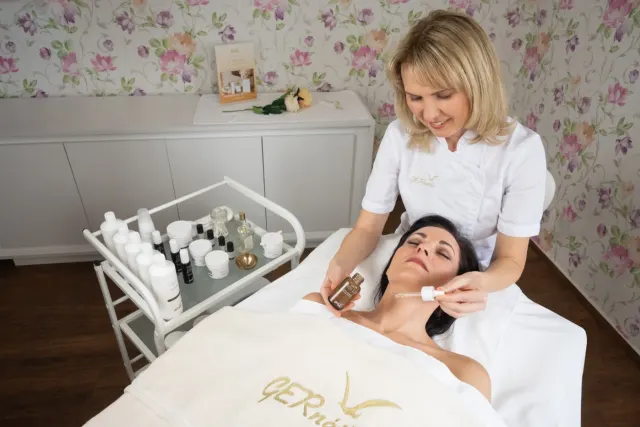
Home care is the foundation, and regular salon visits can significantly support results. Professional treatment allows a more precise skin assessment, more intensive application of active ingredients, targeted regeneration and deep relaxation. Menopause is a stage when skin needs a new approach and greater respect for what is happening in the body.
Menopausal skin care begins with understanding change
Hormonal changes are natural, and we can choose how we respond. Suitable beauty care, a healthy lifestyle and regular attention to our skin can help maintain its beauty, comfort and vitality. Menopausal skin needs care that understands its new needs.